Psilocybin
The active ingredient in magic mushrooms. A mental gain for me, no effect on my motor skills. Prohibited in Germany.
Updated: October 2026
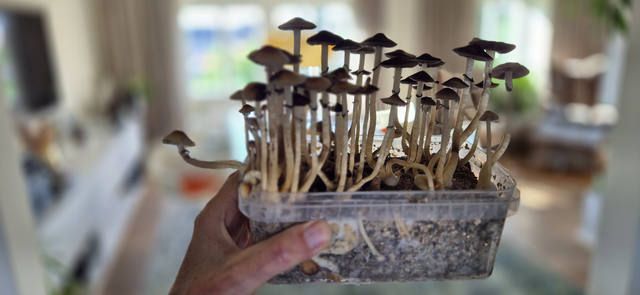
What Is It?
Psilocybin is the active ingredient in so-called magic mushrooms. At higher doses it changes perception and consciousness. In research it is mainly being studied as a treatment for depression.
Important: In Germany, psilocybin is prohibited under the Narcotics Act (Betäubungsmittelgesetz), and that includes possession. Some other countries handle it much more leniently. Psilocybin can trigger mental health crises and is dangerous for people with a history of psychosis.
What Does the Research Say?
In April 2025, a team led by Dr. Ellen Bradley at the University of California, San Francisco, published a pilot study in the journal Neuropsychopharmacology (Neuroscience News). Twelve people with mild to moderate Parkinson's and depression or anxiety, seven men and five women, received 10 mg and, two weeks later, 25 mg of psilocybin, along with a few talk therapy sessions. Mood and anxiety improved clearly and the improvement lasted at least three months. Surprisingly, the motor scores improved too. Side effects such as anxiety, nausea or temporarily raised blood pressure were mild, and there were no serious complications. The researchers suspect that psilocybin promotes neuroplasticity, meaning new connections in the brain, and dampens inflammation. There was no placebo group.
In July 2025 a study was published according to which psilocin extended the lifespan of human cells in the lab, and aged mice given monthly psilocybin lived longer (80 versus 50 percent) (npj Aging). Whether this carries over to humans is completely open.
New (2026): The larger trials are now under way. The University of California, San Francisco, is studying 60 patients with depression in a randomized, blinded trial (UCSF, NCT06455293). Everyone receives two sessions with psilocybin, but at different doses. This makes it possible to separate the actual effect from expectation. The Michael J. Fox Foundation is funding the expansion of the study (Michael J. Fox Foundation). At Yale, a blinded study with 40 participants is running on the same principle (ICH GCP, NCT07610369).
In Germany, psilocybin has been permitted since July 2025 in a compassionate use program for severe, treatment-resistant depression in hospital, among others at the Central Institute of Mental Health in Mannheim (PTAheute). This does not apply to Parkinson's.
Dosage and Effects
The following information comes from studies and generally available sources. It is not a set of instructions. The amount of active substance varies a lot depending on the mushroom variety and how it was grown, often several times over. The same amount can therefore have very different effects.
Dose
- 10 mg of psilocybin, the first dose in the study, corresponds to roughly 1 to 2 grams of dried mushrooms.
- 25 mg of psilocybin, the second dose, corresponds to roughly 2.5 to 5 grams of dried mushrooms.
- Fresh mushrooms are mostly water: 1 gram of fresh mushrooms contains about as much active substance as 0.1 grams of dried ones.
Effects
- Onset: after 30 to 60 minutes
- Peak: after 2 to 3 hours
- Duration: up to about 8 hours in total
Intensity with dried mushrooms
- 0.1 to 0.3 grams: a very small amount (microdosing), usually without a trip. This is how I take it today.
- 0.5 to 3 grams: a mild to strong trip
- 3 to 5 grams or more: a very strong trip
Safety
- Not together with 5-HTP, antidepressants or MAO inhibitors.
- Never take higher doses alone, but with a sober companion and in a calm setting.
- Not with a personal or family history of psychosis, not with serious heart problems or untreated high blood pressure.
- Do not drive on the day you take it.
My Experience
Since May 2025 I have been taking psilocybin at irregular intervals, and only abroad, where it is handled more leniently. I don't take it in Germany. At first I documented every dose: usually 0.3 to 1 gram of dried mushrooms, mostly in the evening. Once, in August 2025, I took a high dose of 5 grams. That was a very intense experience lasting for hours, but it didn't change anything about my motor skills.
These days, when I'm abroad, I take small amounts of 0.1 to 0.3 grams at irregular intervals, in the evening before going to bed. I tolerate it well, sleep about half an hour longer and dream more intensely. I feel more balanced and lighthearted, and life feels more intense to me. Psilocybin has shown no effect on my motor skills.
My neurologist knows about it. She recommends taking it only now and then and not daily, and she explicitly points out that psilocybin must not be taken together with 5-HTP, because otherwise there is a risk of a dangerous serotonin syndrome.
My Conclusion
As exciting as the research is, especially for mood: because of the legal situation and the risks, I can't recommend psilocybin to anyone. If you are interested in it, look for official studies.