Focused Ultrasound
A procedure without an incision that can greatly ease the tremor in particular. An overview.
Updated: October 2026

What Is It?
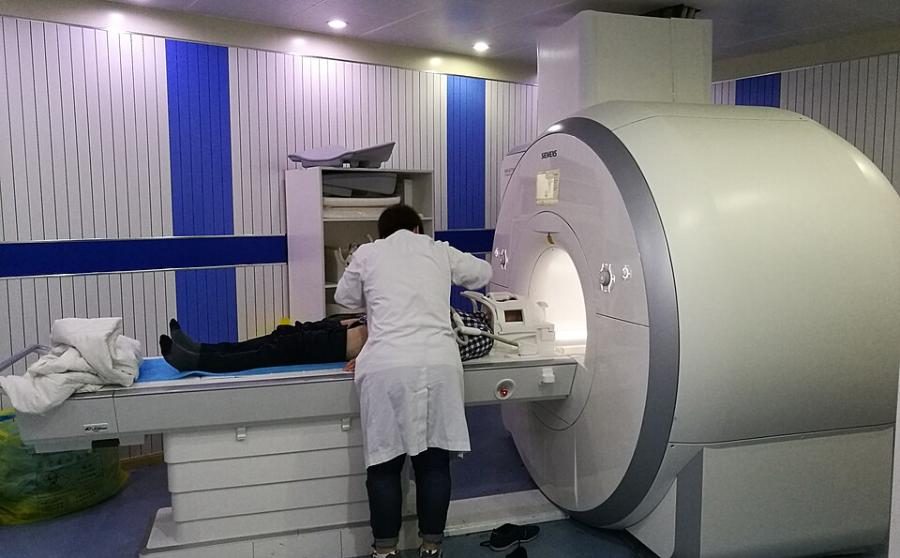
In MRI-guided focused ultrasound (MRgFUS), ultrasound waves are focused on a spot in the brain just a few millimeters in size, without a skin incision and without general anesthesia. The heat this creates permanently switches off abnormally active nerve cells at that spot. It is a neurosurgical procedure, not a gentle method.
For Which Symptoms?
The target point in the brain is what matters:
- Tremor (thalamus): the best evidence. In essential tremor, the shaking goes down by 60 to 70 percent on average, often right away. It also works well in tremor-dominant Parkinson's.
- Slowness and stiffness (subthalamic nucleus): a newer approach. Studies report more than 50 percent less tremor, stiffness and slowness on the treated side. Long-term data for treating both sides is still missing.
- Motor fluctuations and dyskinesia (pallidothalamic tract): the new US approval for treating both sides refers to this target.
For a long time only one side of the body was treated. If the tremor affects both sides, the second side can now also be treated at the thalamus in a second procedure some time later. This is a different target from the one in the new US approval for treating both sides in Parkinson's (see below). The procedure is mainly meant for people who have had Parkinson's for several years and whose symptoms can no longer be treated well enough by other means, not for the early stage. In Parkinson's, the effect can wear off again over the years because the disease progresses.
Both sides (new since 2025): In 2025 the US FDA approved treatment of both sides of the body for the first time, in two procedures at least six months apart, for motor fluctuations and dyskinesia (Michael J. Fox Foundation). The approval study appeared in The Lancet Neurology in 2026. Of 54 patients, 40 were treated on both sides. Motor fluctuations and dyskinesia fell by about two thirds, and the effect lasted at least one year. However, lasting problems with speech, gait or balance occurred in about one in four patients after the second side, compared with about 2 percent after only one side (NeurologyLive).
Safety
Compared with deep brain stimulation, there is no incision and no implant. Serious lasting complications are rare (1 to 2 percent). Temporary numbness, walking and balance problems or mild speech problems are common, and they usually fade within weeks to months.
Centers in Germany
Experienced centers include UKSH Kiel (the largest number of cases, also doing research on treating slowness and stiffness), Universitätsklinikum Bonn (since 2018), Paracelsus-Elena-Klinik Kassel, Universitätsklinikum Freiburg and, since 2025, Sana Duisburg.
Cost
A one-sided treatment usually costs 15,000 to 25,000 euros. For essential tremor, German health insurers often cover the cost; for Parkinson's, they decide case by case. Always submit a cost estimate and an application to your insurer beforehand.
My Assessment
I have not had focused ultrasound, and at my early stage it is not an option for me. But for people with advanced disease and a strong tremor, on one side or both, it is an important option that you should know about.