Alzheimer's
Many of the building blocks I use against my Parkinson's are also being researched in Alzheimer's. TPS is even approved for Alzheimer's.
Updated: October 2026
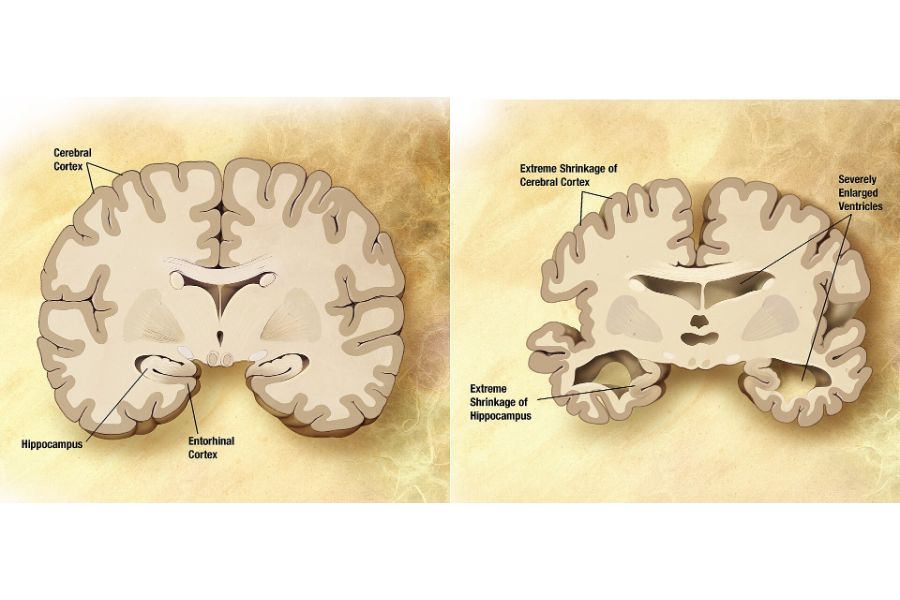

Alzheimer's is the most common form of dementia. In Germany, around one million people live with Alzheimer's dementia. The proteins beta-amyloid and tau build up in the brain, and nerve cells die, first in the memory center, the hippocampus.
Parkinson's and Alzheimer's have a lot in common: weakened mitochondria, inflammation in the brain, misfolded proteins and impaired self-cleaning of the cells. That is why many of the methods I use are also studied in Alzheimer's, some of them even there first. I do not have Alzheimer's myself. Here I show where my building blocks overlap with Alzheimer's research.
Conventional medicine
- Antibodies against amyloid: In Germany, Leqembi (lecanemab) has been available since September 2025 and Kisunla (donanemab) since November 2025. They clear amyloid deposits and slow the disease, but do not cure it. Only people in the early stage with confirmed amyloid are eligible, by estimates about one percent of those affected. The infusions require regular MRI checks, because brain swelling and small brain bleeds can occur.
- Established treatments: Drugs such as donepezil have been used for years and ease symptoms for a while. The ginkgo special extract EGb 761 is also approved for dementia in Germany. An analysis of four studies with 782 patients with mild dementia found better results with 240 mg a day than with placebo in 2025, for thinking, daily life and quality of life. One of the authors works for the manufacturer. More on ginkgo under Ginkgo biloba.
My building blocks and Alzheimer's
- TPS (transcranial pulse stimulation): The shockwave device NEUROLITH has been approved for Alzheimer's since 2018; in Parkinson's it is used off-label. In the most important study so far, from the Medical University of Vienna (JAMA Network Open, February 2025), 60 patients received the real treatment and a sham treatment in turn. Overall, the difference in the memory test was not clear-cut. In patients up to 70, however, memory improved markedly, and MRI showed more active memory networks. The treatment was safe (JAMA Network Open). I have been going for TPS once a month since 2021.
- Lithium and Dr. Michael Nehls: The physician Dr. Michael Nehls has worked on Alzheimer's for years and points out how important lithium is for the brain. In August 2025, Harvard Medical School showed in Nature that lithium in the brain drops very early in Alzheimer's because the amyloid deposits bind it. In mice, very low-dose lithium orotate prevented the typical changes and memory loss and even reversed them. This has not yet been tested in humans (Harvard Gazette). A first small study of lithium orotate in 40 Alzheimer's patients is registered and is due to start at the end of 2026. A pilot study of low-dose lithium carbonate in 80 people with mild cognitive impairment (JAMA Neurology, March 2026) found a slower loss of verbal memory after two years, which narrowly missed the study's strict target. Lithium was safe. I have been taking lithium orotate since 2024.
- NeuroEpo from Cuba: The largest placebo-controlled study of NeuroEpo was not in Parkinson's but in Alzheimer's. In the Cuban ATHENEA study (2023), 174 patients received NeuroEpo or a placebo as a nasal spray three times a week for 48 weeks. With NeuroEpo, memory tests improved slightly; with placebo they got worse. A study with 90 Alzheimer's patients is registered in Canada. I was treated with NeuroEpo in Havana in 2022 and 2024.
- Light at 40 hertz: In Alzheimer's, gamma waves in the brain are often weaker. In animal studies, 40-hertz stimulation reduced the deposits. According to ClinicalTrials.gov, the large US study of the Vielight Neuro Gamma in Alzheimer's has been suspended, and there are no results. The company Cognito is further along with light and sound at 40 hertz: in a smaller study, patients lost fewer everyday abilities and less brain volume than with sham treatment; the large approval study is still running. I use the Vielight three times a week in gamma mode.
- Hyperbaric oxygen therapy: Researchers at Tel Aviv University reduced deposits and inflammation in Alzheimer's mice by around 40 percent with pressurized oxygen. In humans there are only small studies. I have my own pressure chamber.
- Sauna: In a Finnish study of 2,315 men over about 20 years, men who used the sauna four to seven times a week had an approximately 65 percent lower risk of Alzheimer's than men who went once a week. This is an association, not proof. I use an infrared sauna at home; more under Sleep, sauna and cold.
What you can do yourself
The Lancet Commission, a large international group of experts, concluded in 2024 that about 45 percent of all dementia cases could be prevented or delayed by eliminating 14 risk factors:
- little education, hearing loss and untreated vision loss
- high blood pressure, high LDL cholesterol, diabetes and obesity
- physical inactivity, smoking and too much alcohol
- depression and social isolation
- head injuries and air pollution
For me, exercise is the most important "medicine", for Parkinson's as for Alzheimer's. Add to that good sleep, good blood values and plenty of contact with other people.
My conclusion
Alzheimer's and Parkinson's are close relatives. Several of my building blocks are even better studied in Alzheimer's than in Parkinson's, above all TPS, NeuroEpo and lithium. But here, too, much is not yet proven. Anyone affected should first visit a good memory clinic and discuss further steps with their doctor.