TMS
Magnetic stimulation of the brain's movement center. Well studied, but no noticeable effect for me.
Updated: October 2026
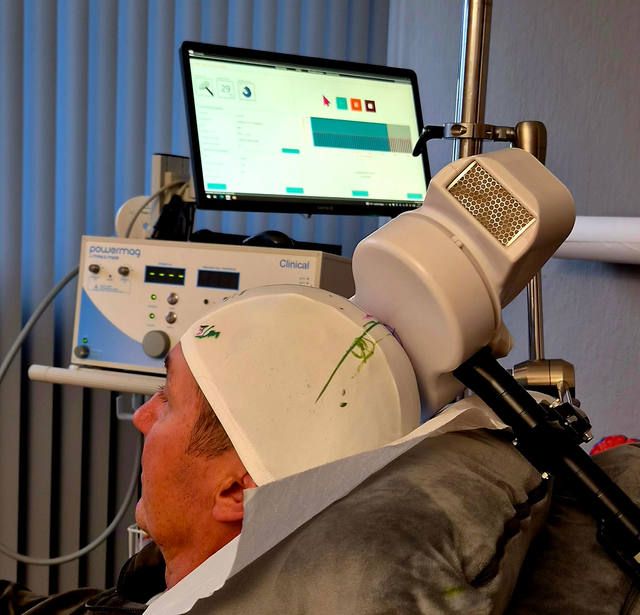
What is it?
In transcranial magnetic stimulation (TMS), a coil placed on the head creates strong, short magnetic fields that trigger weak electrical currents in specific brain regions. In Germany, the method is recognized for depression. For Parkinson's, the motor cortex is usually stimulated, which is the brain region that controls movement.
What does the research say?
There are many small studies on TMS in Parkinson's that use sham treatment for comparison. Pooled analyses show a moderate improvement in motor function, especially with high-frequency stimulation of the motor cortex on both sides, for example in stiffness, slowness, gait and freezing. The effect builds up over several sessions, but often lasts only a few weeks. The team led by Prof. Eman Khedr at Assiut University in Egypt has done a particularly large amount of research: there, high-frequency stimulation worked better and longer than low-frequency stimulation. TMS can also ease depressive symptoms in Parkinson's.
My experience
I made a first short attempt in December 2024. From March 30 to mid-April 2026, I followed with an accelerated treatment, mostly two sessions a day, 30 in total, at Neurostimulation Mannheim, where I have the treatment done:
- Device: PowerMAG BA Clinical (Mag & More)
- Target: motor cortex on both sides
- 10 Hz, 2,000 pulses per session, a little over 12 minutes
During the stimulation, my hand twitched now and then. This is typical for this kind of stimulation and harmless. Overall, I became more restless and nervous during this time, because I was doing too many things at once. I did not notice any improvement.
My conclusion
TMS is well studied and worth a try for Parkinson's, especially for mood problems. For me it brought nothing noticeable, partly because I wanted too much at once.