Tanganil and N-Acetyl-L-Leucine
An old, inexpensive amino acid from France that made headlines in 2024. So far it has done nothing for me, but it remains exciting.
Updated: October 2026
What is it?
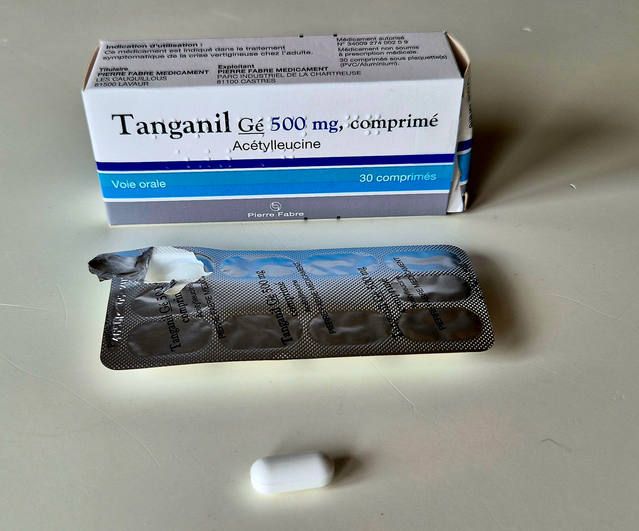
Tanganil is a drug from France that has been sold there without a prescription for dizziness since 1960. The active ingredient is acetyl-DL-leucine, a modified amino acid. It consists of equal parts of two mirror-image forms: the L-form and the D-form. The pure L-form is called N-acetyl-L-leucine (NALL for short).
What does the research say?
September 2024: Prof. Wolfgang Oertel of the University of Marburg reported in Nature Communications on two patients with REM sleep behavior disorder, a common early sign of Parkinson's. On acetyl-DL-leucine, their symptoms improved, and imaging of the dopamine system partly improved. The German Neurological Society called it a "sensational observation." But these are single cases.
2025: The same group described three patients with advanced multiple system atrophy, a disease related to Parkinson's. Their walking and balance got clearly worse. At this stage, the authors tend to advise against it.
March 2026: Researchers at Northwestern University in Chicago led by Prof. Dimitri Krainc showed in the Journal of Clinical Investigation, using nerve cells from Parkinson's patients and in mice: the L-form lowers the diseased alpha-synuclein. In doing so, it activates the protective protein HTRA1, increases the protein Parkin and improves the function of nerve connections. The pure L-form is approved as a drug for the rare Niemann-Pick disease type C, in the USA since September 2024 and in the EU since January 2026. It is not approved for Parkinson's.
Controlled studies in people with Parkinson's are still pending.
Sources: Oertel et al., Nature Communications 2024 · Song et al., Journal of Clinical Investigation 2026
June 2025: Prof. Oertel described a 67-year-old man with Parkinson's and REM sleep behavior disorder who lashed out in his dreams. On 5 grams of acetyl-DL-leucine a day, the symptoms largely disappeared over 24 months. During two breaks they returned (Journal of Neurology). It is a single case; there is no placebo-controlled study on this yet.
My experience
On September 14, 2024, I started taking Tanganil and increased the dose within one week to 5 grams a day (10 tablets, spread over morning, noon and evening), as in the Marburg publication. Since February 25, 2025, I have been taking 2.5 grams of the pure L-form instead. That equals the same amount of active L-leucine.
- Side effects: none
- Worsening: none
- Effect on my symptoms: after two years, none that I can clearly attribute to it
- Mood: very good, but I use many methods at the same time, including lithium
I keep taking NALL anyway, because other people with Parkinson's report positive experiences in the forums. At a conference, Prof. Strupp from Munich mentioned 4.5 grams a day as a possibly better dose. I am thinking about increasing it.
Practical tips on the L-form
NALL comes as a powder. It does not dissolve in water, so I use a precision scale to fill it into capsules of about 500 mg each. At 2.5 grams a day you need about 900 grams a year, at 4.5 grams about 1,600 grams. If that is too much work for you, you are better off sticking with Tanganil tablets.
Unfortunately, I can't name any sources because of legal cease-and-desist letters. Please don't write to me about it.
Effort and cost
At 5 grams a day, Tanganil costs about 500 euros a year, NALL at 2.5 grams about 300 euros. Tanganil is available without a prescription in France but is not approved in Germany. Getting it has become more difficult.
My conclusion
So far, Tanganil has done nothing for me. Still, I consider it one of the most exciting discoveries of recent years: an old, inexpensive and well-tolerated drug. If the observations are confirmed in larger studies, it could help above all people in the prodromal or early stage. Please talk to your doctor before taking it.