Stem Cells
My most expensive treatment so far. I have not noticed any effect on my Parkinson's yet.
Updated: October 2026
What Is It?
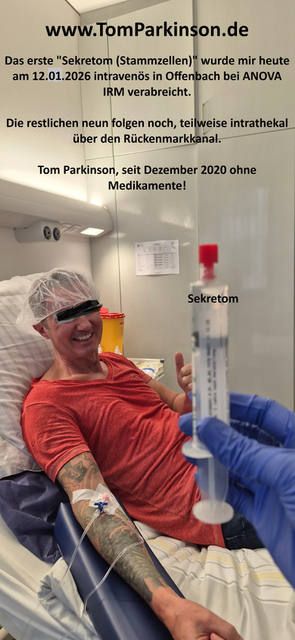
In the treatment I had, stem cells are taken from my own belly fat and multiplied in the lab (mesenchymal stem cells). They are not meant to form new nerve cells. Instead, through their signaling substances, they are meant to calm inflammation and protect damaged cells. Some providers don't give the cells themselves but their secretome, meaning all the substances the cells release: exosomes, proteins and signaling molecules. They are given through a vein or into the spinal canal.
Something completely different are dopamine nerve cells grown from stem cells and transplanted directly into the brain. More on that further down.
What Does the Research Say?
- Japan and South Korea, November 2024: The report of 136 successfully treated patients was based on one clinic's analysis without a comparison group.
- USA, end of 2025: The Hope Biosciences Research Foundation reported a study with 60 patients and a placebo group, though using fat-derived stem cells from donors. After six infusions, the UPDRS Part III as rated by the doctor improved much more than with placebo. But the patients themselves did not rate their everyday mobility as better. A large confirmatory study is still pending.
How stem cells age and whether they can be rejuvenated is explained by Prof. Hartmut Geiger, head of the Institute of Molecular Medicine at Ulm University, in conversation with Nina Ruge. Among other things, he researches the compound Casin, which made aged blood stem cells younger again in experiments.
Important: In Germany, stem cell therapies for Parkinson's are not an approved treatment. Medical societies around the world warn against expensive offers with unproven effects.
My Experience
I chose ANOVA in Offenbach.
- December 2, 2025: removal of belly fat. Ten batches were produced from it.
- January 12, 2026: first batch
- March 4, 2026: three more batches
- May 29, 2026: two batches into the spinal canal. Afterward I had a strong, constant tremor in my left hand for a few days, which then settled down again.
To this day I have not noticed any improvement in my symptoms, if anything slight worsening. I don't know whether the treatment does anything for longevity. I still have four batches left. I am considering having two more given into the spinal canal and two into the blood at the end of 2026 or the beginning of 2027, but I haven't decided yet.
Two Parkinson's patients I am in contact with were treated by Prof. Alt in Munich in December 2024, for around 10,000 euros. For them too, there was no change through January 2026. At the time, Prof. Alt did not want to treat me because he said my symptoms were too mild.
Effort and Costs
The first step cost around 20,000 euros. It included three batches: the first one in January and two of the three batches in March. From the fourth batch on, each additional batch costs 2,250 euros. If I use all ten, the treatment will cost around 35,750 euros. You pay the costs yourself.
Dopamine Cells From Stem Cells: The Future
Dopamine nerve precursor cells, grown from stem cells and injected directly into the brain, work in a completely different way. In February 2026, an expert panel of the Japanese Ministry of Health became the first in the world to recommend approval of such a therapy made from iPS cells: Amchepry by Sumitomo Pharma (Kyodo News). You can read more about these approaches under My Path and My Plans.
In July 2026 the next good news came from Europe: the STEM-PD trial from Lund in Sweden showed in eight patients that such cells made from stem cells can be implanted safely. Details under Research 2026.
As of October 2026: Conditional approval of Amchepry, limited to seven years, followed on March 6, 2026, for patients in whom levodopa is no longer sufficient. It was based on a study with only seven patients. Within those seven years, its effectiveness must be confirmed in everyday clinical practice (Sumitomo Chemical). In May 2026, reimbursement by Japanese health insurance was approved at a price of about 55 million yen per patient (roughly 350,000 US dollars). Treatments are due to start before the end of 2026 (Parkinson's News Today). In May 2026, Novo Nordisk handed the Lund therapy from STEM-PD to the company Cellular Intelligence; a phase 2 study is due to start at the end of 2026 or the beginning of 2027 (Fierce Biotech). After one year, six of seven patients were able to reduce their dopamine medication considerably. In South Korea, the company S.Biomedics reported clearly better motor scores in 12 patients after two years, though without a comparison group (Edaily). In the USA, the pivotal trial of BlueRock's bemdaneprocel has been running since 2025, with around 100 patients and sham surgery as the comparison. The company Aspen, which makes the cells from the patient's own skin cells, reported improvements in eight patients after one year in March 2026, also without a comparison group, and is planning a phase 3 study (Parkinson's News Today).
My Conclusion
Stem cell therapy was my most expensive single treatment so far, and in my case it hasn't done anything yet. Find out as much as you can beforehand, ask about controlled studies, and only spend the money if you can live with losing it if it doesn't work.