PDCare by SYMBYX
Light therapy for the belly and neck that is meant to work through the gut-brain axis. I have been using it since 2021.
Updated: October 2026
Important (July 2026): SYMBYX has ceased commercial operations. Since July 23, 2026, new devices can no longer be ordered. Existing warranties remain valid; inquiries go to info@symbyxbiome.com (Parkinson's Insights). I keep using my laser.
What Is It?
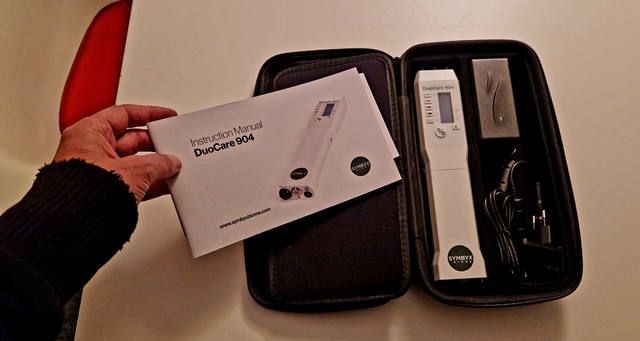
PDCare is a laser device for home use made by the Australian company SYMBYX. It works with invisible light in the near-infrared range (904 nm), which is aimed at nine points on the belly and at the neck. This is called photobiomodulation: the light is absorbed by the mitochondria and is meant to boost the cells' energy production, curb inflammation, improve blood flow and have a positive effect on the gut flora.
The idea: if Parkinson's begins in the gut for many people, treating the belly goes right to that spot. SYMBYX also offers a light helmet for the head, the Neuro Helm.
What Does the Research Say?
The team around the Australian researcher Ann Liebert has published several studies:
- 2021: A first small study without a control group showed improvements in mobility, balance and fine motor skills.
- 2023: In a study with 40 patients, the light helmet proved to be safe and well tolerated.
- 2024: The participants of the first study were followed for five more years. In the six participants who continued treatment, improvements in walking, balance and thinking were maintained, while motor function on UPDRS Part III stayed the same overall. There were no side effects (BMC Neurology).
- 2025: In the largest study so far, with 63 patients in Canada, the helmet and the laser were combined. In the first eight weeks there was no difference compared with the sham treatment. Among those who kept going for months afterward, walking and coping with daily life improved and anxiety decreased, in each case compared with those who stopped. This is not proof, because that comparison was no longer blinded.
- 2026: In these six long-term participants, the gut flora also changed over five years, including less Desulfovibrio. Without a control group, however, it is impossible to say whether this was due to the light (Journal of Clinical Medicine).
At Flinders University in Adelaide, a six-month double-blind study with the PDCare laser was announced in 2022. No results have been published so far.
Overall analysis (August 2026): A meta-analysis of 8 studies with 279 patients found no clear effect of light therapy on motor symptoms. On UPDRS part III, the difference from sham treatment was only about 1.4 points. The treatment was safe, but the authors rate the evidence as very low (Brain Sciences).
My Experience
Since September 20, 2021, I have been using the PDCare laser three times a week, following the protocol from the studies. I also own the Neuro Helm. I have had no side effects. PDCare is part of the combination that brought my turnaround in the fall of 2021, and for me it is one of the methods that come right after the three most important ones.
Effort and Costs
The PDCare laser costs around 1,350 euros as a one-time purchase, the Neuro Helm around 1,000 euros. No health insurer covers the costs. Each session takes only a few minutes and fits easily into everyday life.
My Conclusion
A simple, well-tolerated building block that I have kept up for five years. If you try it, use it for months, because you can hardly expect anything in the short term.